This bowie knife review: explains why U.S. states in the middle 1800's passed legislation that made homicides with a bowie knife a felony
Even if the killing was self defense
By Jack Corbett
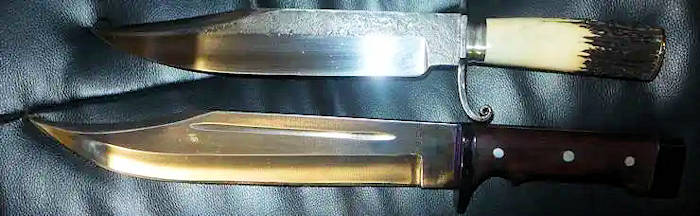
| Note how massive the Alamo Kukri House bowie is. It's another 12 ounces heavier than a Cold Steel Natchez bowie that is oftentimes refereed to as a short sword. The bowie knife above the Alamo bowie knife is the exquisite Mark Morrow Arkansas fighting bowie. In the 1830's and 1840's when it came to a duel this much lighter and livelier bowie was the preferred style because it was far more deadly than much heavier bowies. |
Real Cognoscenti of exquisitely made knives oftentimes regard Bill Bagwell's custom Bowie knives as the finest fighting Bowie knives of all time.It costs a minimum of $2000 and a 2 year wait to get one of Bagwell's masterpieces. But Bill Bagwell is also hugely successful at self promotion. In fact, he's so good at it, that I'm almost certain that almost anyone who reads Bowies, Big Knives and the Best of Battle Blades will wind up believing nearly every word Bill writes.
The book makes fascinating reading, however. But the real question is, is the bowie knife as effective as Bill claims it to be?
Bill claims for example that the back cut makes the bowie knife an awesome killer of men.
Bill's theories on the incomparable lethality of the back cut are not, however, substantiated by what I've found on the internet that might vindicate him. But they do make sense.
|
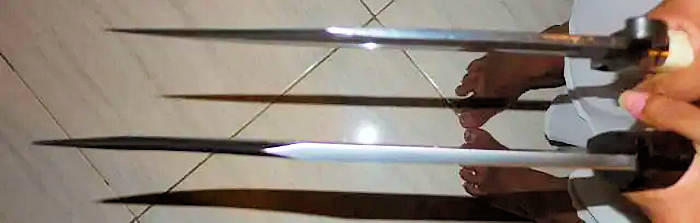
The Cold Steel Trailmasters are renowned for their very thick blades. The Cold Steel web site shows such knives being subjected to all sorts of abuse from being bent 90 degrees in a vice to being thrust through car doors, etc. Although the Mark Morrow Arkansas fighting bowie has a wider blade it much thinner than the Trailmasters. I doubt if it will withstand nearly the abuse. Nevertheless in my bowie knife review , the Mark Morrow stands supreme as a fighting knife par excellence. |
|
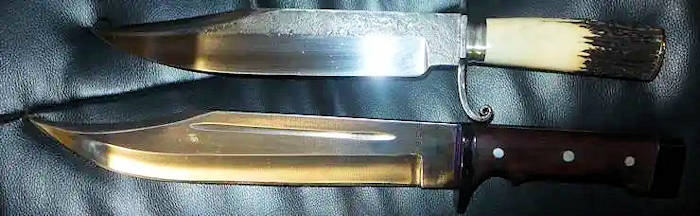
Note how massive the Alamo Kukri House bowie is. It's another 12 ounces heavier than a Cold Steel Natchez bowie that is oftentimes refereed to as a short sword |
|
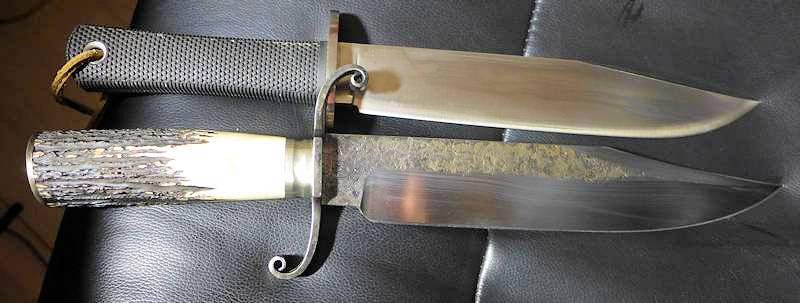
Above is the Cold Steel Trailmaster in Japanese San Mai steel. Below, the Mark Morrow hand made Arkansas Fighting bowie. The Cold Steel is a survival knife, one of the best there is with its 3/8th inch thick blade. It's great for splitting logs, making shelters, etc and with its razor sharp edge, not bad in a self defense role also. The Mark Morrow Arkansas fighting bowie feels lighter than the Trailmasters yet it weighs nearly 2 ounces more. It has a razor sharp false edge for delivering lethal back cuts. The blade is also wider than the Trailmasters so its going to make a larger entry hole in an adversary. But the Trailmasters will stand up to a lot more abuse. The Arkansas fighting bowie's main reason for its existence is to kill people. Whereas Cold Steel designed the Trailmasters to excel in the woods. |
|
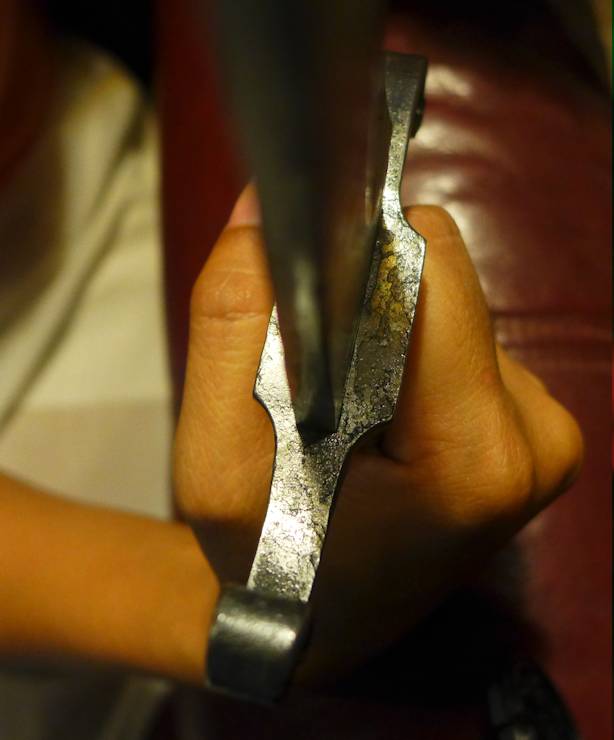
Notice the hammer marks along this topside of the Mark Morrow Arkansas Fighting bowie's guard. Such hammer marks also appear all along the back side of the blade as well as on part of the blade itself. Mark did this on purpose to give the knife a great antique finish. There is nothing quite like the feel of a custom knife from a true craftsman. |
I had to find out, and it was my quest for finding the truth that drove me to making this bowie knife review video.
The video you are about to see is much more than just a review of a Cold Steel Trailmaster, a Nepalese Kukri House Alamo Bowie a custom Mark Morrow Bowie knife and the Kuhkuri House Dbad Defender. it is a test of Bill Bagwell's backcut theories as well.

Click on the picture above to watch the video
 Video:
This video compares the size, weight and Killing power
of three Bowie Knives
Video:
This video compares the size, weight and Killing power
of three Bowie Knives
To put Bagwell's theory to the test. I inflated several balloons and bought several small plastic water bottles
What separates true Bowie knives from other edged weapons is its ingenious point design. This design incorporates a sharpened false edge on the back side of the blade that extends three to four inches down from the point. Bill contends that the full force of a blow delivered from the point and this back edge is concentrated into such a small area that devastating things happen instantly to an adversaries body parts receiving the blow.
After reading Bagwell's book and seeing one of his you tube videos, I started imaging a man's intestines being ripped open with terrific force that will spill his guts out onto the floor as easily as a gunnysack of oats would spill its contents at the slightest cut. Such thoughts never left my mind, and I wound up doing my own bowie knife review to determine if this were at all plausible.
But I had to wait a year and a half to do my own Bowie knife review because I had just ordered a Mark Morrow hand made Arkansas fighting bowie, and I wound up having to wait SO LONG to get it.
During this long wait I bought a Japanese made Cold Steel Trailmaster in San Mai laminated steel even though I already had an American made Trailmaster in Carbon V steel that's been with me for twenty years.
But the wait went on and on so when I found out that Kukri House was offering a limited production run of just 25 numbered Alamo style bowie knives I shot my order into Nepal right off.
Five weeks later, the Alamo bowie arrived at my Thailand condo. It's a massive knife with an 11 inch blade that weighs 34 ounces. That's just as heavy as two of my Nepalese Kukris. Everything about the Alamo bowie is first rate. The handle feels terrific in the hand. The knives lines are simple and beautiful. Its steel has that wondrous ring to it that many excellent steels seem to have.
In the You Tube bowie knife review I talk about how Confederate Civil War soldiers started off carrying huge bowie knives as their secondary weapons.
I allude to how such Confederate soldiers bragged to one another about how "My thing is bigger than your thing".
The typical Confederate Bowie knife was so large and heavy that soldiers usually wound up discarding them.
Civil War soldiers on both sides resorted to using bayonets or the butts of their muskets for hand to hand combat. And so it would be with the Kukri House Nepalese Alamo bowie. It offers unparalleled power for separating limbs and heads But it's too heavy to be carrying about for very long.
Civil War sabers and Bowie Knives could not compete with bayonets and the new cap and ball revolvers.
The six shot percussion revolver became the preferred weapon of most cavalrymen, particularly by such irregulars as Quantrill's raiders. Such horsemen usually carried at least two revolvers due to their unreliability. While many of them carried as many as six revolvers at one time.
One of the reasons why a horseman carried so many revolvers is that they were unreliable.
Each revolver had six chambers. And each chamber had a nipple next to it on which the soldier placed a percussion cap. Among other things (such as the cap failing to ignite) a spent cap oftentimes fell into the revolvers mechanism. Thus causing a jam, and that such jams often occurred every 11 rounds or so. It would not be until 1873 that the Colt Single Action Army solved this unreliability issue.
Prior to 1836 soldiers typically carried flintlock single shot black powder weapons. A man had one shot, and that was it. Needless to say Bowie knives became very popular in those days. And if Bill Bagwell is to be believed, extremely deadly. But the Patterson cap and ball revolver of 1836 brought on enormous change. And Samuel Colt took the Patterson revolver and ran with it. Now a man had 5 or 6 shots at his command. Which caused a decline in the popularity of the Bowie knife as a defensive weapon.
had to wait a year and a half for Mark Morrow's Arkansas fighting Bowie knife. Only then could I do my Bowie knife review. I'd also for the first time do my own private investigation of the Bowie knife back cut's lethality.
Video:
Bill Bagwell's Deadly Backcut. Is Bill right?
And how about the Jack Corbett point of View?



|
|